 Umbrachyx
Darkness is faster than light.
The database that remembers the past.
Your data was changed, and nobody can say when, by whom, or why.
Here every change is kept, with who made it, why, and who approved it.
Reads answer in tens of microseconds, even while writes keep coming.
If the current value is the light, its history is the shadow that was there before the light arrived.
WHY IT HAPPENS
A database holds only the current value, and a write is production the moment it lands. Keeping the past was slow, so it was left to logs and backups → now AI agents write too: fast, many, sometimes wrong → by the time someone notices, the old value and the reason are gone.
Here the history is not a log beside the data; it is how the data is held, in memory, so asking a value where it came from costs about what reading it does. And narrowing an agent's permissions by configuration fails with one wrong setting, so an agent has no way to write to production to begin with. The token an agent is given names its branch; it cannot write anywhere else, and it cannot approve. (The one exception is a table declared to keep no history: it has no branches, and there the token decides only which keys.) What a hijacked agent was tested not to be able to do is listed with the tests.
WHAT IT IS
Umbrachyx is an in-memory database that keeps every change as history. Each value knows when it changed, from what to what, who changed it, why, and who approved the change; and the history can be branched, diffed, merged and undone, the way git handles files. It speaks the Redis protocol, so existing clients work, and agents connect through MCP.
- A write is acknowledged only once it is synced to the log. The tree and the history are rebuilt from the log.
- Reads never wait for writes. While writes keep coming, a read answers in tens of microseconds.
- Deleting means destroying a key. Values are encrypted under a key per subject (a player, say). Destroy the key and the values can never be read again, while the shape of the history stays.
QUESTIONS IT CAN ANSWER
- "An item disappeared." When, and in which change?
- "This account has more than it should." Where did it come from, and who approved it?
- "We gave everyone the wrong reward." Take back that one change and keep what came after.
- "Try the new event on real data." On a branch, without touching production.
- "Delete my data." Make that person's values unreadable for good.
Four walkthroughs, each run by the tests as written: a game's inventory, a support desk, settings rolled out in stages and five questions about a game's data.
WHERE IT FITS: THREE MADE-UP CASES
Nobody's production is described here: the three cases are invented, with made-up data. Each one is a walkthrough whose commands the tests run exactly as written.
-
A game's inventory
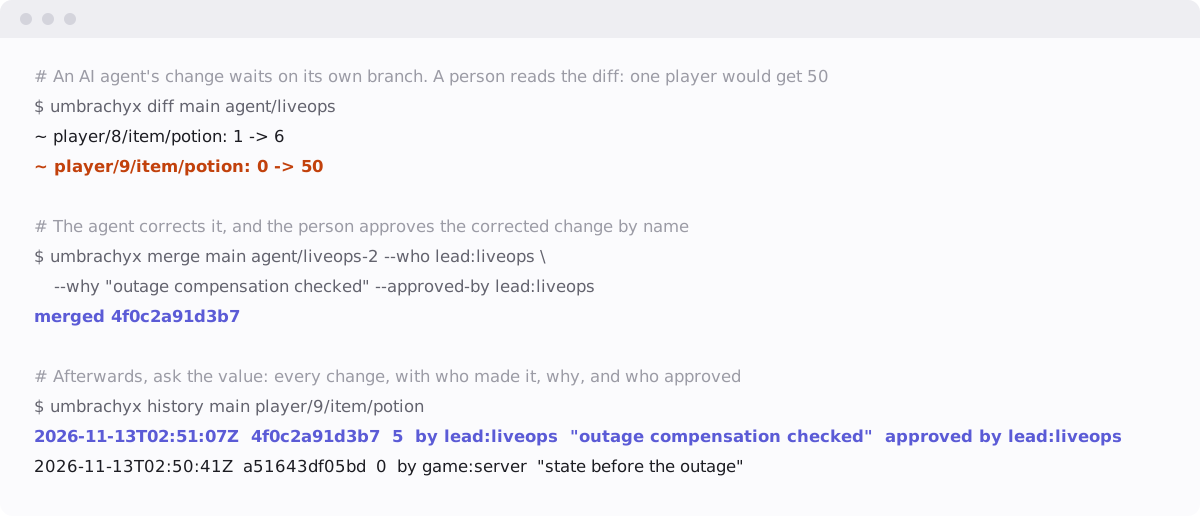
After an outage an agent prepares a grant of potions. The reviewer sees one player would get fifty and sends it back. Meanwhile the game kept writing, and the agent's "3 + 5 = 8" is no longer true: the merge stops and names the key. Walkthrough
-
A support desk
An agent reads tickets and proposes account credits, one branch per ticket. One is approved, one is beyond what the desk may give and is left alone. Later: "who credited customer 31, and who signed it off?" and "delete my data". Walkthrough
-
Settings rolled out in stages
A new checkout goes to a share of visitors, each stage approved by name. At 50% errors rise: that one change is taken back, and a setting someone else changed afterwards stays as it is. Walkthrough
SPEED, WITH THE ROWS WHERE IT LOSES
Measured next to Valkey on the same AWS machine (EC2 m6id.xlarge, Tokyo,
its local NVMe disk). On both sides a write is synced to disk before it is
acknowledged (Valkey with appendfsync always). 32-byte values, a million
keys, synthetic data.
| A second | Umbrachyx | Valkey | |
|---|---|---|---|
| Reads while 50 clients keep writing | 24,667 | 1,758 | about 14× more |
| Reads, one client | 54,377 | 37,216 | about 1.5× more |
| Synced writes, one client | 8,832 | 6,268 | about 1.4× more |
| Reads, 50 clients | 149,477 | 151,745 | 1% fewer |
| Synced writes, 64 clients | 43,649 | 94,473 | about 2.2× fewer |
| Synced writes, 256 clients | 56,577 | 112,360 | about 2.0× fewer |
| Synced writes, 50 clients sending 64 at a time | 84,221 | 626,959 | about 7.4× fewer |
| Memory for each overwrite | about 655 bytes | about 16 bytes | about 40× more |
Every row is the median of three runs on 2026-11-17, and every Umbrachyx row is with all of the history kept. It is not a faster Valkey. With many clients writing at once, and in memory, it is clearly behind: that is what keeping all of the history costs. The raw output, the machine and the steps are in bench/results, and every table, with PostgreSQL and Dolt, is in the README.
Tables that keep no history
A table can be declared to keep only its current values, as Valkey does: no history,
no branches, no review. plain still syncs every write before it answers,
and is set against appendfsync always. plain-async answers
first and syncs within a second, and is set against Valkey's default,
appendfsync everysec.
| A second | Plain | Valkey always |
Plain-async | Valkey everysec |
|---|---|---|---|---|
| 95% reads, 5% writes, 50 clients | 162,179 | 81,269 | 170,792 | 106,042 |
| 50% reads, 50% writes, 50 clients | 124,003 | 72,454 | 156,246 | 100,182 |
| Writes, one client | 10,680 | 6,268 | 29,061 | 34,554 |
| Writes, 64 clients | 90,050 | 94,473 | 106,838 | 156,495 |
| Writes, 50 clients sending 64 at a time | 540,687 | 626,959 | 572,082 | 638,570 |
The same machine and day. With reads in the load, both kinds are ahead of Valkey. Writes alone, a plain-async table is behind on every row, and a plain table from 64 clients up. Starting again after five million writes takes 3.3 seconds with a plain table and 57.5 with the history kept.
Robustness
- The server killed in the middle of writes: 1,100 times, with 2,388,554 writes acknowledged; none lost.
-
Simulated disks and power cuts: four simulations of 10,000 seeds each
(writes torn part way, failed syncs, flipped bits, a clock that goes back), more
than 580,000 restarts in all; no write that waited for the disk went missing. A
plain-asynctable lost only the last puts it had answered early, as it says it may. - All of these run in CI on Linux and Windows for every change.
HOW A CHANGE REACHES PRODUCTION
-
1. Hand over
A person gives the agent a token for one branch, some keys, a purpose and an expiry.
-
2. Write
The agent writes to its branch, with a reason. Production does not change.
-
3. Look
A person picks one from the list of changes waiting and reads its diff.
-
4. Decide
Approved, it enters production with the approver's name. Rejected, it is kept with the reason.
- What is approved is the diff the person saw. If the agent wrote more after that, the approval is refused. Nothing is merged unseen.
- If production moved first, it stops. When both sides changed the same key, nothing is written and the key is named. A conflict is never settled by guessing.
- A token that can approve cannot write, and one that can write cannot approve.
- The list, the diff and the approval can be a screen in a database viewer (dbboard has a tab for it) or commands in a terminal.
WITH DBBOARD
dbboard is a desktop database
viewer from the same author. It connects to umbrachyx serve the way it
connects to a Redis server, and shows what the terminal commands print:
- The history of a key: each value it had, who put it there, why, and who approved.
- The diff between two branches or two commits.
- The changes waiting, each with its diff, and the buttons to approve or reject.
Nothing in this is special to dbboard. The history is asked for with
UMBRA.* commands over the Redis protocol, and any client that speaks
it can send them.
WHERE IT IS GOING
It starts from the history of every value and memory speed. Where it is going is a database an AI agent would choose to work against. An agent keeps no memory between sessions, writes from what it read a while ago, retries, and pays for every byte it reads. So the measure is less operations a second than how cheap one round of read, try and check is, and how cheap a mistake is.
What people ask of a database is what the past taught them: keep the history, be fast, count it in operations a second. That is what this one is held to first, in the table above. The second yardstick came from the AI agent the project is built with. Asked to write this page, it opened with a write nobody had looked at and a branch where being wrong costs nothing; asked why, it said it is the one who writes. Both yardsticks are kept: the old one says how fast, the new one says how cheaply an agent gets to a right answer.
- There today: mistakes that cannot reach production, privileges narrow by structure, the reason kept with every value, refusals in fixed words, and documentation that the tests run.
- Not there yet: a write that states its premise ("8 if it is still 3") or its intent ("add 5"), asking what a token allows before trying, reading a rejection's reason from the agent's own tools, writes that are safe to send twice, and reads that are recorded.
What comes next, in this order
- Faster writes to tables that keep no history, where it is still behind Valkey when many clients only write.
- A cheaper check of an agent's token on every write.
- A log that does not grow for ever: dropping what was overwritten, keeping history for a set time, keys that expire.
- Read-only followers on other machines, and a backup tool.
- Writes that carry what the agent assumed ("set it to 8 if it is still 3"), and a write that counts once when sent twice.
No dates: the order may change with what the measurements say. What is being worked on is in the issues, and what each version brought in the releases.
The whole list is in the concept; for an agent reading this site there is llms.txt.
START
The server alone, in Docker, with its log on a volume. The image is for amd64 and arm64; what each version holds is on the releases page.
$ docker run -d --name umbrachyx -p 127.0.0.1:6380:6380 -v umbrachyx-data:/data ghcr.io/meta-taro/umbrachyx
$ valkey-cli -p 6380 set player/42/gems 100
OK
$ valkey-cli -p 6380 umbra.history app player/42/gems
# the value, the commit's id, when, who, why and who approved, as JSON
-
Publish the port to
127.0.0.1only, as above. Reads need no token yet, and nothing on the connection is encrypted. - To try branches, diffs and approval from the command line, see the five-minute quick start.
- To give an agent a token and connect it, see docs/agents.md.
QUESTIONS PEOPLE ASK
- Can it replace Valkey or Redis? Existing clients connect: the server speaks enough of the Redis protocol for them. But it is not a faster Valkey. Choose it when the questions are "who changed this, why, and who approved it".
- Does everything have to keep its history? No. A table can be declared to keep only current values, for sessions, caches and counters. Those writes are not reviewed and cannot be undone.
-
How does an agent connect? Through MCP (
umbrachyx mcp) or the Redis protocol, with a token a person issued for one branch, some keys, a purpose and an expiry. - How much memory does the history take? About 655 bytes for each overwrite, all of it in memory, and nothing removes old history yet. Size it for the number of writes, not the number of keys.
- Can data be deleted for good? Yes. Values are encrypted under a key per subject; destroying the key makes them unreadable, and the shape of the history stays.
- Is it ready for production? It is one node with no replication and no backup tool. Try it and measure it; do not make it the only copy of data you need.
-
What does a later version do with my data? It opens the log this version
wrote. The key file and the
UMBRA.*commands may still change.
WHAT IT CANNOT DO YET
- It runs on one machine. Replication (read-only followers) is being built; machines cannot be connected yet.
- Everything is held in memory. History grows with every write, and nothing moves old history to disk or limits how long it is kept. Out of memory, the server stops and says why; what it acknowledged is kept.
- It is not ready to be used over a network. Reads need no token and there is no TLS. Use it on one machine, or inside a network you trust.
- There is no backup tool. For now, stop the server and copy the log and the key file together.
- Keys and values only. No range reads, secondary indexes, aggregates or SQL.
- Many clients writing at once get a fraction of what Valkey gives them, as the table shows.
- Power cuts have only been simulated. Cutting the power of real hardware, and runs that last for days, are still to come.
- Approvals that need two people, and rules checked at approval (types, ranges), do not exist yet.